
If you’ve ever wondered where an animal goes after it disappears into the wild—or even where your livestock roams all day—you’re not alone. From wildlife researchers and conservationists to farmers and animal welfare organizations, the demand for a gps tracker for animals has exploded in recent years. And with advances in technology, modern gps tracking devices for animals are smarter, lighter, and more reliable than ever.
In this in-depth guide, we will break everything down in simple, human language. No tech overload. Just real answers to real questions—exactly what an AEO-based (Answer Engine Optimization) blog is meant to do.
Firm Story:
Telemetry Solutions is a trusted U.S.-based provider of advanced animal tracking and telemetry systems. With decades of experience, the company has become a go-to partner for wildlife researchers, government agencies, universities, and conservation organizations worldwide.
What sets Telemetry Solutions apart?
- Deep technical expertise
- Species-specific device design
- Reliable data delivery
- Long-term research support
- Commitment to ethical wildlife tracking
From concept to deployment, Telemetry Solutions focuses on precision, durability, and real-world usability.
Industries We Serve at Telemetry Solutions:
Telemetry Solutions supports a wide range of industries that rely on tracking devices for animals, including:
- Wildlife Conservation
Tracking endangered species, understanding migration routes, and protecting habitats.
- Academic & Scientific Research
Universities and research institutes use a gps tracker for animal to study behavior, ecology, and climate impact.
- Government & Environmental Agencies
Monitoring protected areas, wildlife populations, and conservation compliance.
- Public Health & Disease Control
Tracking animal movement to understand the spread of zoonotic diseases.
- Agriculture & Livestock Management
Improving herd management, reducing loss, and enhancing productivity.
Key Partners Who Trust Telemetry Solutions:
At Telemetry Solutions, our GPS tracking technology is trusted by research teams, wildlife professionals, and government agencies around the world. Over the years, our clients have gone on to collaborate with — and deliver projects for — some of the most respected institutions in conservation, public health, environmental management, and academia.
Telemetry Solutions collaborates with globally respected organizations, including:
- Iowa Department of Natural Resources
- Università degli Studi di Firenze (University of Florence)
- Centers for Disease Control and Prevention (CDC)
- NSW National Parks and Wildlife Service
- Oregon Department of Fish & Wildlife
- University of Melbourne
- U.S. National Park Service (NPS)
- Texas A&M University
- University of British Columbia (UBC)
- KEO International Consultants
These partnerships highlight the reliability and scientific credibility of Telemetry Solutions tracking devices for animals.
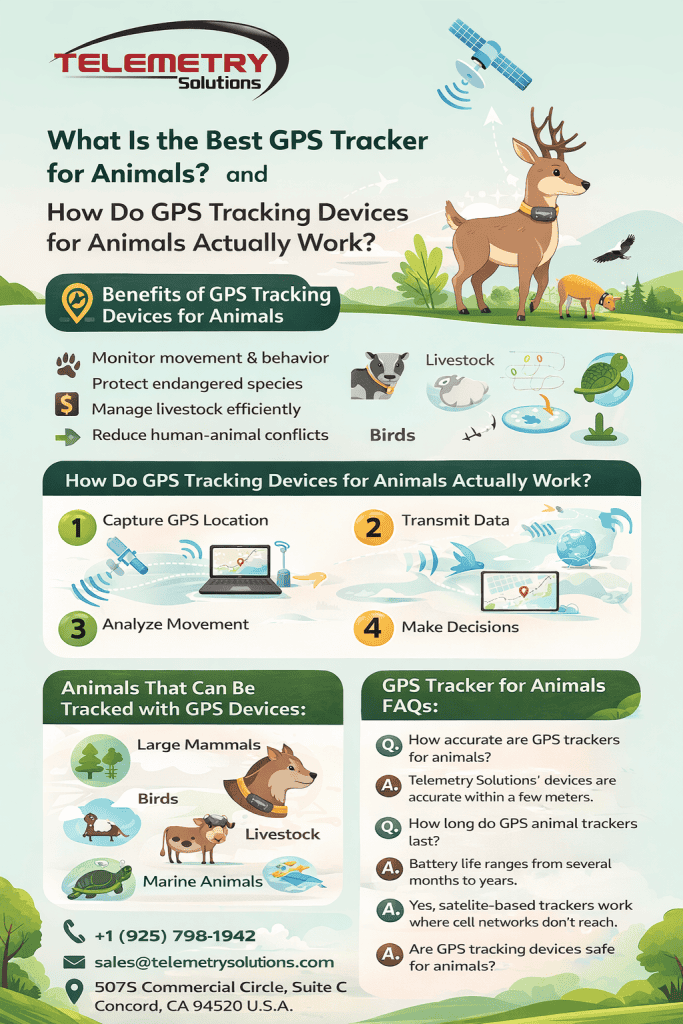
Why Do Animals Need GPS Tracking in the First Place?
Animals don’t come with a “Find My Location” button—yet. That’s where GPS technology steps in.
A gps tracker for animals helps researchers, conservation teams, and organizations understand:
- Where animals travel
- How they use habitats
- When they migrate
- How human activity affects them
- Whether they’re safe or at risk
Meanwhile, tracking devices for animals also play a huge role in:
- Livestock management
- Wildlife protection
- Disease monitoring
- Environmental research
- Reducing human–animal conflict
In short: GPS tracking saves time, saves resources, and often saves lives.
Telemetry Solutions also provides comprehensive support and expert guidance that ensure researchers and wildlife professionals succeed in the field. Their wildlife telemetry services go far beyond device manufacturing — they include equipment evaluation, base station repair, data extraction, troubleshooting support, refurbishment of existing units, and a reliable one-year warranty on all GPS products. These services help minimize downtime, extend device lifespan, and ensure trusted performance across deployments.
What Exactly Is a GPS Tracker for Animals?
A gps tracker for animals is a small electronic device attached to an animal via a collar, harness, tag, or implant. It uses satellite-based GPS signals to collect precise location data and transmits that data to researchers or managers.
Most modern gps tracking devices for animals include:
- GPS satellite positioning
- Data storage or real-time transmission
- Long-life batteries or solar power
- Lightweight, animal-safe designs
- Environmental sensors (optional)
At Telemetry Solutions, devices are designed specifically to match animal size, behavior, and environment—because one tracker does not fit all.
How Do GPS Tracking Devices for Animals Work Step by Step?
Here’s the simple version:
- Location Capture
The GPS tracker receives signals from satellites to determine the animal’s exact location. - Data Logging or Transmission
The data is either stored onboard or transmitted via satellite, cellular, or radio networks. - Data Analysis
Researchers access the data through secure platforms to analyze movement patterns, habitat use, and behavior. - Decision Making
Insights from tracking devices for animals help inform conservation strategies, policy decisions, and animal management plans.
What Types of Animals Can Be Tracked Using GPS?
A common myth is that GPS tracking is only for large wildlife. In reality, a gps tracker for animal that can be customized for many species, including:
- Large mammals (wolves, deer, bears, big cats)
- Marine animals (sharks, turtles, seals)
- Birds (eagles, migratory birds)
- Livestock (cattle, sheep, goats)
- Smaller mammals (depending on weight and behavior)
Telemetry Solutions specializes in species-appropriate designs, ensuring safety and accuracy.
Why Choose Advanced GPS Tracking Devices for Animals Over Traditional Methods?
Old-school tracking relied on observation, tagging, or VHF radio signals. While useful, they had limits.
Modern tracking devices for animals offer:
- Higher accuracy
- Continuous data collection
- Remote access to data
- Lower long-term field costs
- Reduced disturbance to animals
Simply put: more insight, less guesswork.
How Accurate Is a GPS Tracker for Animals?
Accuracy depends on:
- Satellite visibility
- Terrain
- Device quality
- Data transmission method
High-quality gps tracking devices for animals, like those provided by Telemetry Solutions, can achieve accuracy within a few meters—making them ideal for scientific and operational use.
In addition, Telemetry Solutions has developed a detailed Wildlife GPS Buying Guide to help customers make informed decisions before selecting GPS tracking systems.
The guide walks through critical considerations such as weight limits appropriate for study species, battery life expectations under varying environmental conditions, design and attachment methods, and data acquisition options including radio or satellite transmission. This resource also explains how different GPS scheduling options, sensor capabilities, and customer support services can impact real-world research outcomes.
Together, these services and resources ensure that customers are not just purchasing a GPS device but gaining long-term support and expert insight tailored to the unique needs of every animal tracking project.
What Features Should You Look for in a GPS Tracker for Animals?
When choosing a gps tracker for animals, consider:
- Battery Life: Longer deployments mean fewer recaptures.
- Weight & Size: Must suit the species.
- Data Transmission: Satellite, cellular, or store-on-board.
- Durability: Weatherproof and rugged.
- Sensor Options: Temperature, activity, mortality alerts.
- Ethical Design: Animal safety always comes first.
Telemetry Solutions checks all these boxes.
Are GPS Tracking Devices for Animals Ethical and Safe?
Yes—when done correctly.
Professionally designed gps tracking devices for animals:
- Follow animal welfare guidelines
- Are tested for comfort and safety
- Are approved by research ethics committees
- Minimize stress and interference
Telemetry Solutions works closely with researchers to ensure responsible deployment.
Frequently Asked Questions {FAQ}:
- What is the lifespan of a GPS tracker for animals?
Battery life can range from months to several years, depending on tracking frequency and device type.
- Can GPS tracking devices for animals work in remote areas?
Yes. Satellite-based devices work even where cellular networks don’t exist.
- Is data collected in real time?
Some devices offer real-time tracking, while others store data for later retrieval.
- Are GPS trackers waterproof?
High-quality animal trackers are designed to withstand harsh environmental conditions, including water exposure.
- Who typically uses a GPS tracker for animal?
Researchers, conservationists, government agencies, universities, and livestock managers.
Conclusion:
A gps tracker for animals is no longer a luxury—it’s a necessity in today’s data-driven world. Whether the goal is conservation, research, disease prevention, or livestock management, gps tracking devices for animals provide unmatched insight into animal movement and behavior.
Telemetry Solutions stands at the forefront of this technology, combining innovation, ethics, and real-world experience to deliver tracking systems you can trust.
Get in Touch with Telemetry Solutions:
📍 Address:
5075 Commercial Circle, Suite C
Concord, CA 94520, U.S.A.
📞 Phone: +1 (925) 798-1942
📧 Email: sales@telemetrysolutions.com
Follow us on Social Media:
Facebook: https://www.facebook.com/TelemetrySolutions/
YouTube: https://www.youtube.com/@TelemetrySolutions
Bluesky: https://bsky.app/profile/telemetrysolutions.bsky.social
Google Business Profile: https://share.google/e7Y1EKPIifA1hsiig
🔗 Explore GPS Animal Tracking Solutions today!